




Showing posts with label 1-SEO. Show all posts

15 Jan 2015

BOOST YOUR SEO TOOLS

No matter the size or purpose of your website, Search Engine Optimization (SEO) is vital if you want to be found online.
You likely know this already. While it’s easy to understand the importance of SEO, it can be a bit challenging to determine exactly what tools you should use to help you improve your site’s search engine rankings. So, it’s time for another one of my helpful lists: 6 tools to help you boost your SEO.
The following list includes free and paid tools that will help you to improve your site’s searchability, visibility, and thus findability. The tools featured in this list will help you with some of the core SEO tasks that you as a digital marketer need to utilize in order to be found online. There are many, many more tools available online. This list is merely a compilation of tools we at 9 Clouds have found helpful for our digital marketing efforts.

1. GOOGLE KEYWORD PLANNERkeyword research

The Google Keyword Planner is a great tool for finding the best keywords for your site. The powerful tool allows you to brainstorm keywords, refine search results, view keyword data by geography, unearth historical keyword data to determine seasonality trends, create a full keyword plan, and determine keywords to go after based on competitor’s websites.
Even though this tool is free, you’ll need a Google AdWords account in order to access this tool. If you don’t already have an account, it’s easy to set one up and you don’t have to commit to make a payment.

2. GOOGLE WEBMASTER TOOLS

Another great Google tool for monitoring and optimizing your site’s SEO is Webmaster Tools. Once you sign up and your site has been verified, you can see when and how often it shows up for keywords, your top 25 keywords, impression data, what pages have been indexed to your site, links that are pointing to your site, average search positions and more. As the Google Webmasters say themselves, “You want to be found on the web. We want to help.” Put simply, this tool helps you to see your website as Google sees it and make adjustments accordingly.
One caveat of Google Webmaster Tools is that it only shows you the impressions you get from keywords that you already rank for, not for potential keywords. Thus, Webmaster Tools offers the most value when it is used in conjunction with the Keyword planner or another keyword research tool to find new keyword possibilities.

3. SEO QUAKE

The SEO Quake toolbar is a great tool to add to your SEO optimization arsenal. The toolbar allows you to access a wide variety of helpful SEO tools while browsing the Internet. You can customize search results, access keyword density reports, monitor competitor site’s SEO, get link counts and much more — all while browsing the web!
You can download the toolbar for free and try it out.
Looking for more SEO toolbar options? A few months ago, I compiled a list of other plugins that offer a host of SEO optimization features for a variety of browsers.

4. MOZ

Moz offers a suite of tools that are all designed to help you continually analyze and refine your website and optimize your SEO all at the same time. Some of the specific features of the Moz tools suite include: analyzing site regularity, managing your SEO, website crawling and rank tracking, social media monitoring and management, analytical reporting, and research capabilities.
Learn more about the suite of Moz tools and their pricing models.
Aside from their premium suite offerings, Moz has a few free standalone services that help with specific aspects of SEO. One of these tools, Get Listed, is a great tool to optimize your online business listings. Simply type in your business name and the zip code, and Get Listed will show you which business listings you already have claimed,  and which business listing services that you have yet to claim. It also provides the links to claim your listing on each service, all from one handy page.
Another great tool for targeted link building is Open Site Explorer. The tool allows you to enter a website and in return it provides you with details about other sites that link to it. This easy-to-use tool is a great way to monitor your competitor’s site links.

5. UBERSUGGEST

A bit more simple than the Google Keyword Planner, Ubersuggest is a free program that allows users to quickly and easily generate keyword ideas. Powered by Google Suggest, Ubersuggest works by scraping search results, adding a letter or digit to your search term and generating a list of suggested keywords keywords
based on those results.
This tool was developed with ease of use in mind, making it a great way to quickly brainstorm and find keywords that users in your niche target are searching for. When you type in your keywords and hit “enter”, you’re presented with nearly 400 recommended phrases.

6. LIVE KEYWORD ANALYSIS

While finding the right keywords is pivotal to the SEO effectiveness of your website, finding the right balance of those keywords is almost just as important. Creating the best keyword density on your own can be challenging, even if you know what percentage you want to shoot for. Enter the Live Keyword Analysis tool. This tool is very easy to use and it is a great way to check and optimize your keyword density.
To use the tool, just enter the keywords you want to target and paste in your text. The tool will then immediately analyze the text and produce your keyword density. The site also provides tips and tricks to help you ensure you’re getting the most SEO value from the tool as possible.

FINAL TIP: JUST KEEP OPTIMIZING

Search engine optimization takes a lot of work. And it usually takes quite a long time for that hard work to actually pay off in terms of better search results and higher rankings — you have to be patient. Don’t jump to conclusions and immediately assume your hard work was for nothing. Many times, it takes weeks, and possibly even months, to see results.
One final tip: Never utilize any Black Hat SEO tactics, like keyword stuffing, invisible text or doorway pages or any other unethical tactics to try to improve your search engine rankings…the search engines will notice. And when they do, your site goes onto their list. This is not a good list! Once you’re on, it’s nearly impossible to get off. Not only does your site’s reputation suffer, but with it, so does your SEO.
So just keep up the hard work, remember that it’s all worth it, and avoid black hat techniques like the plague.

Source from: https://9clouds.com/author/abby/
13 Jan 2015

How to Boost Your SEO by Using Schema Markup


One of the latest evolutions in SEO is called schema markup. This new form of optimization is one of the most powerful, but least-utilized forms of SEO available today. Once you grasp the concept and method of schema markup, you can boost your website in the search engine result pages (SERPs).


My goal in this article is to show you exactly how to get started using schema markup for your website.

First, let’s understand what schema markup is.

Schema markup is code (semantic vocabulary) that you put on your website to help the search engines return more informative results for users. If you’ve ever used rich snippets, you’ll understand exactly what schema markup is all about.
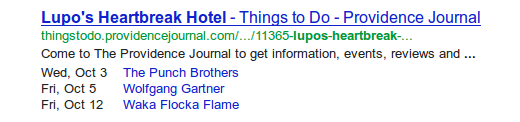
Here’s an example of a local business that has markup on its event schedule page. The SERP entry looks like this:
google search result
The schema markup told the SERP to display a schedule of upcoming hotel events. That, for the user, is exceptionally helpful.
Here are some facts about schema markup:

Schema tells the search engines what your data means, not just what it says.

The content on your website gets indexed and returned in search results. Obviously. But with schema markup, some of that content gets indexed and returned in a different way.
How? Because the markup tells the search engine what that content means. For example, let’s say the word “Neil Patel” appears on an article. The search engine sees this, and produces a SERP entry with “Neil Patel.” However, if I put the right schema markup around the name “Neil Patel,” I’ve just told that search engine that “Neil Patel” is the author of the article, not just a couple random words. The search engine then provides results that display better information for the user who was searching for “Neil Patel.”
Schema.org explains it this way:
Most webmasters are familiar with HTML tags on their pages. Usually, HTML tags tell the browser how to display the information included in the tag. For example,

Avatar

tells the browser to display the text string “Avatar” in a heading 1 format. However, the HTML tag doesn’t give any information about what that text string means — “Avatar” could refer to the hugely successful 3D movie, or it could refer to a type of profile picture—and this can make it more difficult for search engines to intelligently display relevant content to a user.

Schema markup uses a unique semantic vocabulary in microdata format.

You don’t need to learn any new coding skills. Web pages with markup still use HTML. The only difference is adding bits of schema.org vocabulary to HTML Microdata.

Schema.org, the website for schema markup, was created by a collaborative team from Google, Bing, and Yahoo.

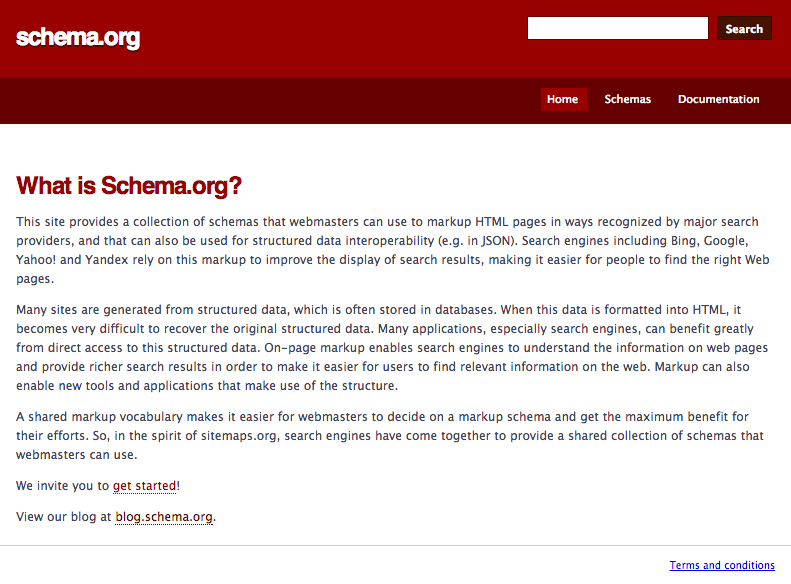
what is schema.org
It’s not too often that competitors come together to help each other, but Schema.org is exactly that kind of inter-industry collaboration. What you have, then, is an agreed-upon set of code markers that tells the major search engines what to do with the data on your website.

Schema markup was invented for users.

When a website has schema markup in place, users can see in the SERPs what a website is all about, where they are, what they do, how much stuff costs, plus plenty of other stuff. Some people have taken to calling schema markup “your virtual business card.”
This is a user-focused improvement. Search engines exist for users to gain the information they need. Schema markup does exactly that.

Second, let’s understand why it’s so important.

Schema markup helps your website rank better for all kinds of content types. There is data markup for…
  • Articles
  • Local businesses
  • Restaurants
  • TV episodes and ratings
  • Book Reviews
  • Movies
  • Software Applications
  • Events
  • Products
There are hundreds of markup types — from toy stores to medical dose schedules. If you have any type of data on your website, there’s a good chance that it’s going to have an associated itemscope and itemtype.
Websites that use schema markup will rank better in the SERPs than companies without markup. One study determined that websites with markup rank an average of four positions higher in the SERPs than those without schema markup. While it’snot totally clear that this higher result is due to the markup alone, there is obviously some correlation.
Right now, one third of Google’s search results incorporate rich snippets, which includes schema markup. However, according to Searchmetrics, only 0.3 of all websites use schema markup.
In other words, there are millions of websites missing out on a huge source of SEO potential. If you use schema markup, you’ll automatically have a leg up on the vast majority of your competition.

Third, let’s understand how to use schema markup on your website.

Now, let’s talk about how to use schema markup. Your goal is to rank better, look better, and do better in the SERPs and in front of users.
Schema markup will help you. With your website in hand, follow these steps.

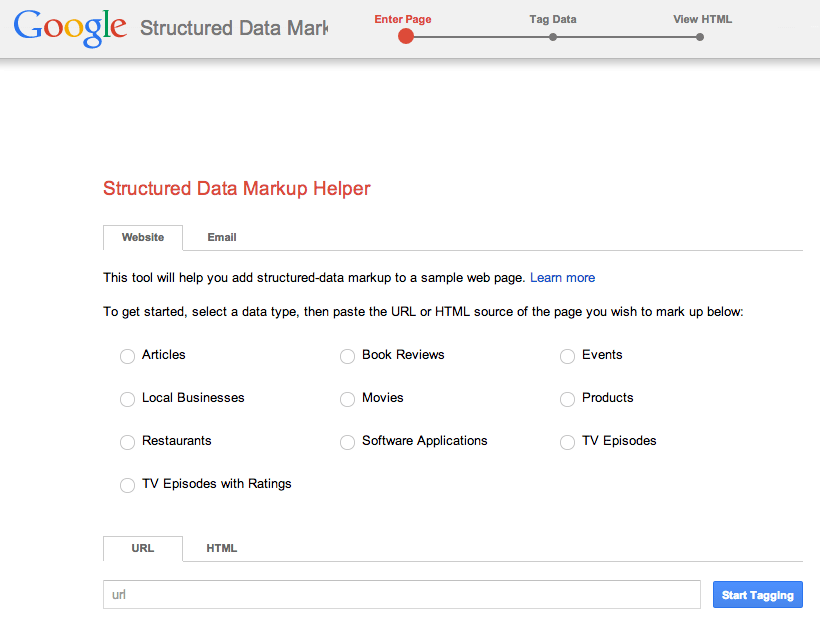
1. Go to Google’s Structured Data Markup Helper.

google structured data markup helper

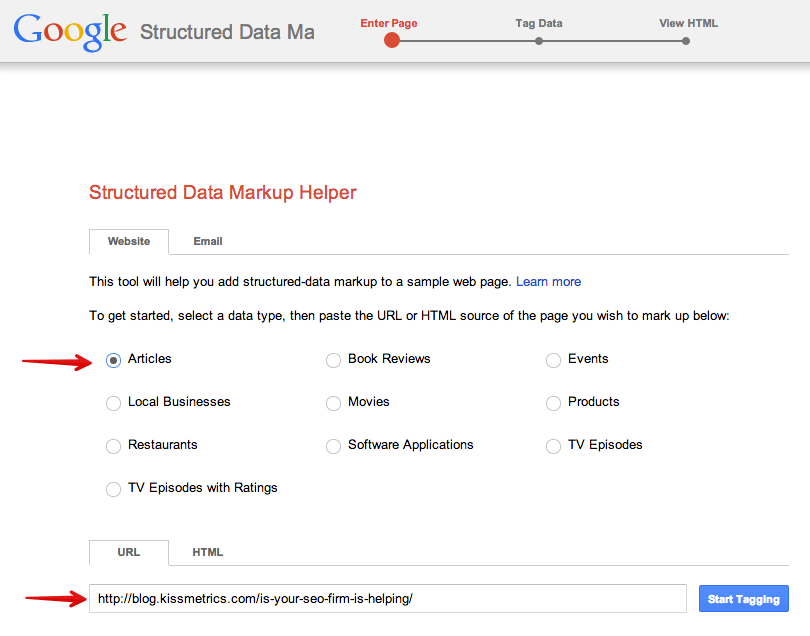
2. Select the type of data that you plan to markup.

There are several options listed. This list is not exhaustive. For the sample below, I’m going to use “Articles” since it’s one of the most common types of content.

3. Paste in the URL of the page or article that you want to markup.

If you only have HTML, you can paste that instead. Then, click “Start Tagging.”
structured data markup helper
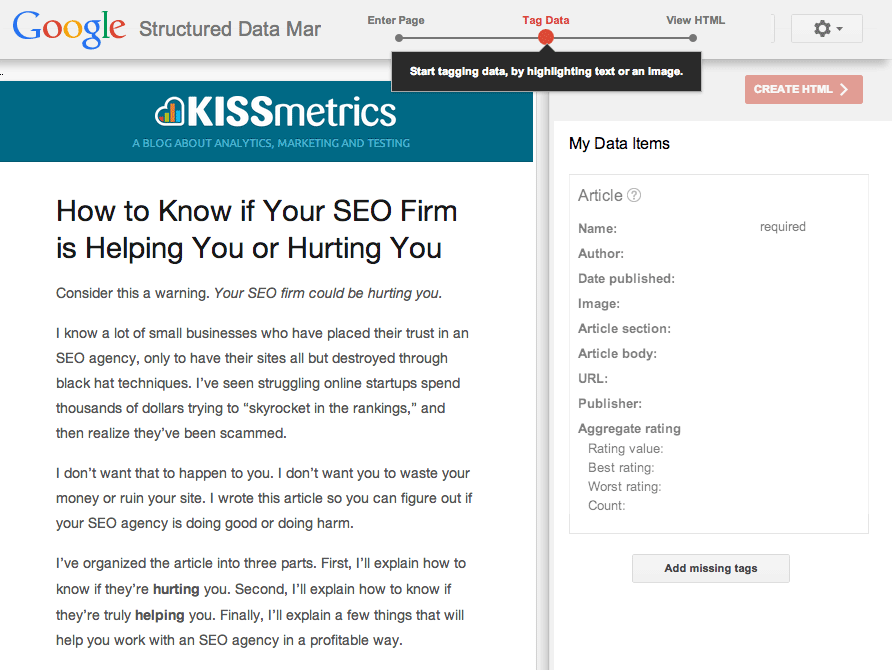
The page will load in the markup tool, and provide you with the workspace for the next phase of markup — tagging items. You’ll see your web page in the left pane, and the data items in the right pane.
structured data markup

4. Highlight and select the type of elements to be marked up.

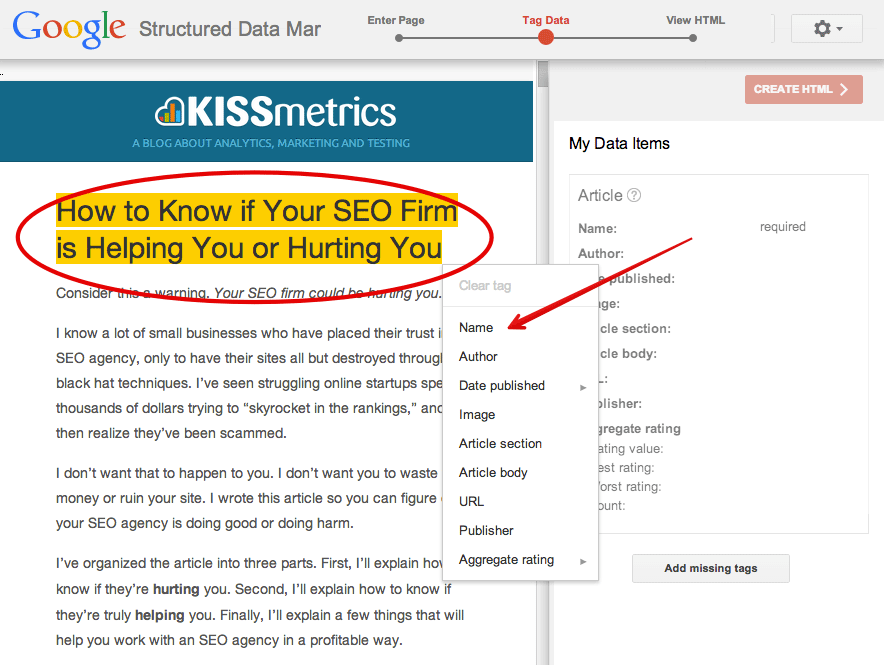
Since this piece of content from KISSmetrics is an article, I’m going to highlight the name of the article in order to add “Name” markup. When I finish highlighting, I select “Name” from the tool tip.
structured data markup
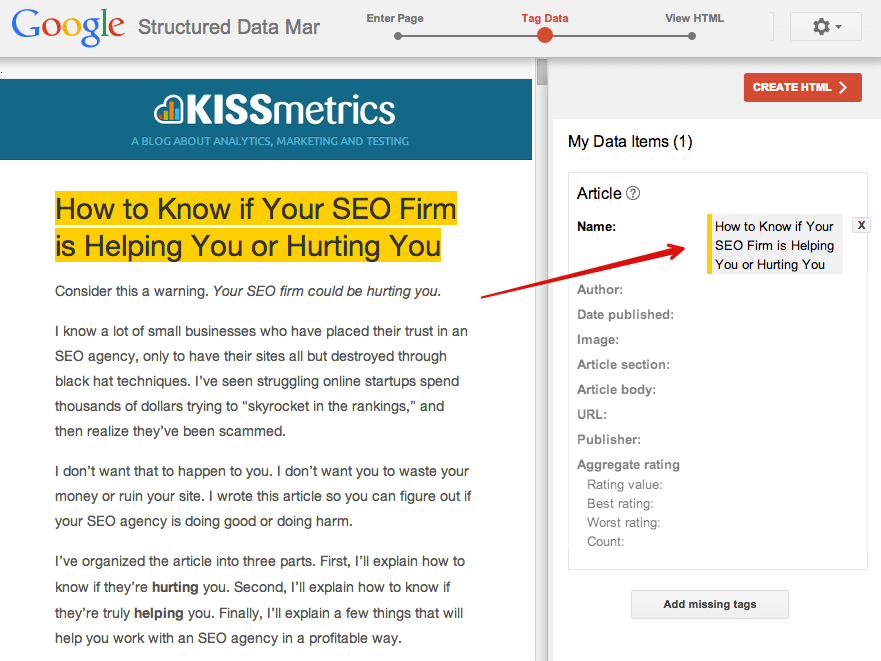
When I select “Name,” the tool adds it to “Data Items” in the right pane.
structured data markup

5. Continue adding markup items.

Use the list of data items as a guide, and highlight the other items in your article to add them to the markup list. You probably won’t be able to tag every item in the list. Just add what you can.

6. Create the HTML.

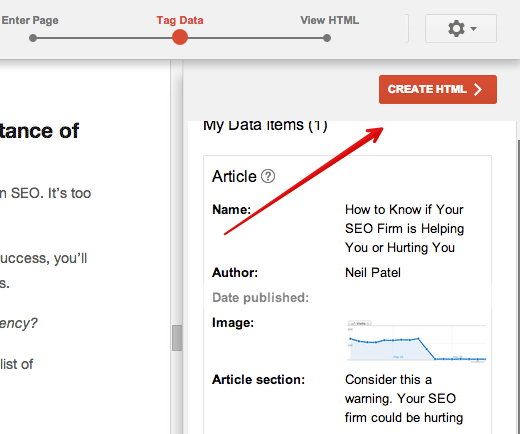
Once you’ve finished, click “Create HTML.”
create html
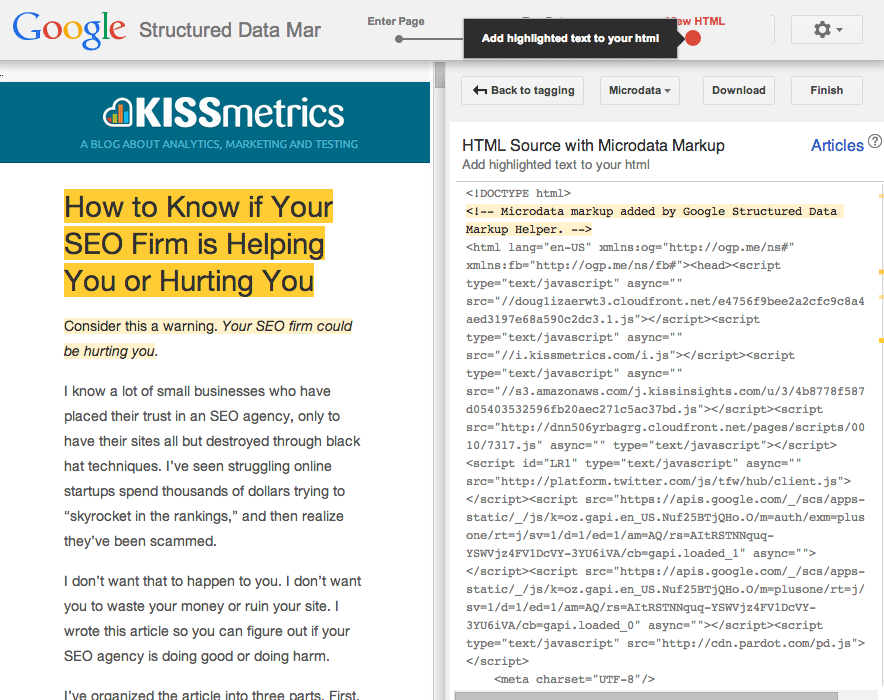
In the following page, you will see the HTML of your page with the relevant microdata inserted in the spots that you selected.
google structured data markup helper

7. Add schema markup to your web page.

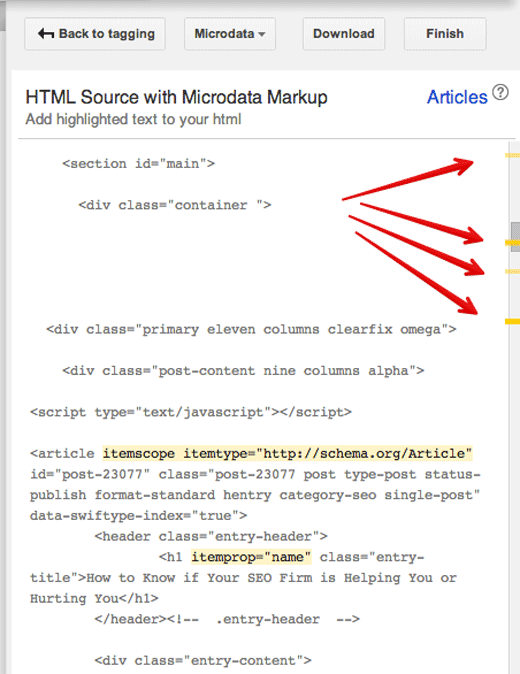
Next, you will go into your CMS (or source code if you’re not using a CMS) and add the highlighted snippets in the appropriate spots. Find the yellow markers on the scrollbar to find the schema markup code.
yellow bars that point to the correct markup
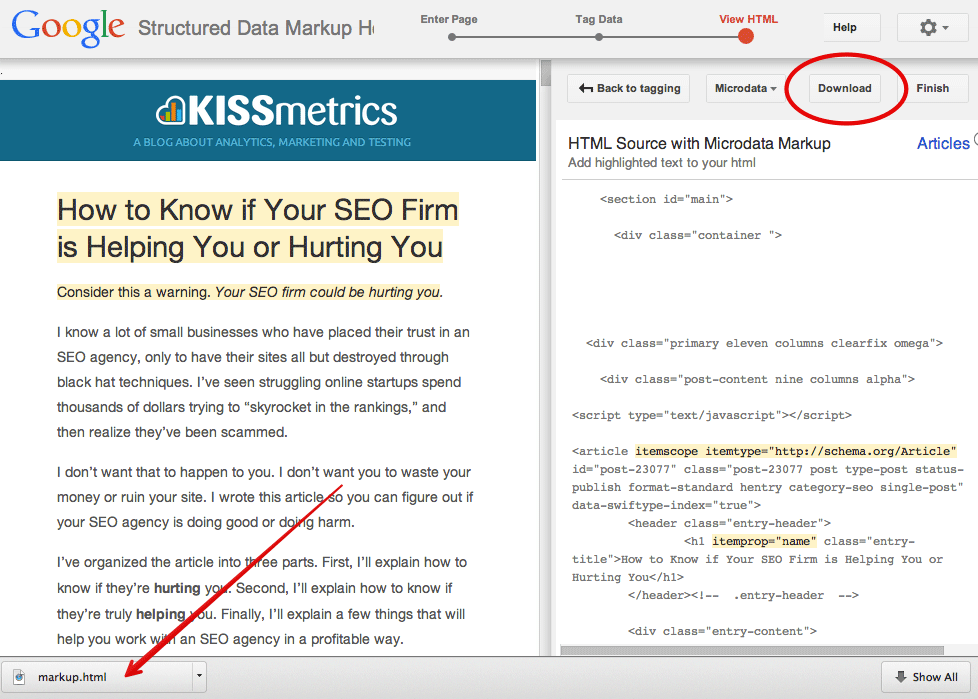
A simple alternative is to download the automatically-generated HTML file, and copy/paste it into your CMS or source code.
structure data markup download
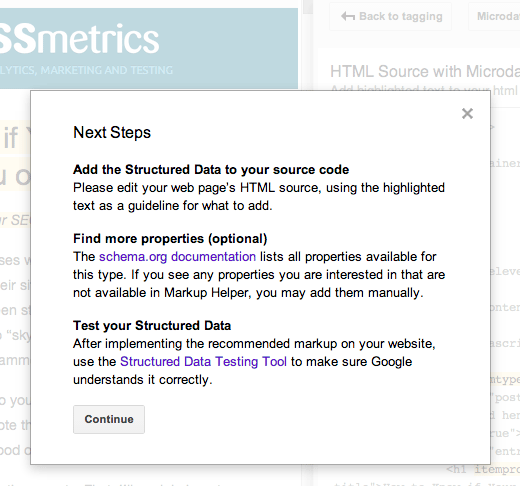
When you click “Finish,” you will be presented with a series of “Next Steps.”
next step

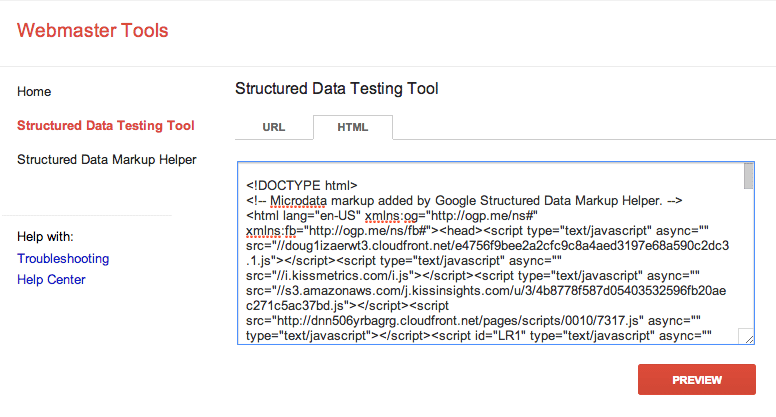
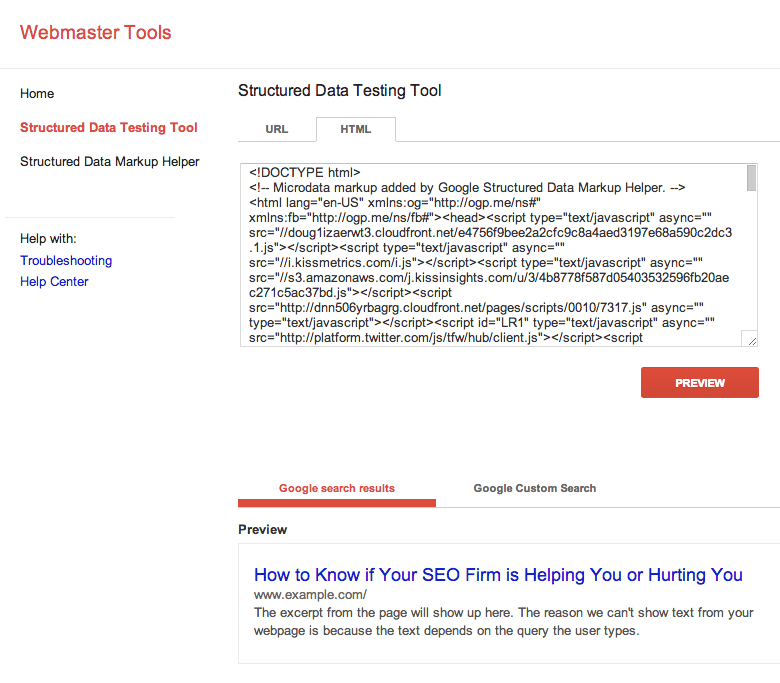
8. Use the Structured Data Testing Tool to find out what your page will look like with the added markup.

Instead of analyzing a published web page, I’m going to analyze the code that the tool generated for me, and which I downloaded.
structured data tool
Once the code is pasted, I click “preview.” The testing tool shows me what the article will look like in Google search results:
14 structured data testing tool
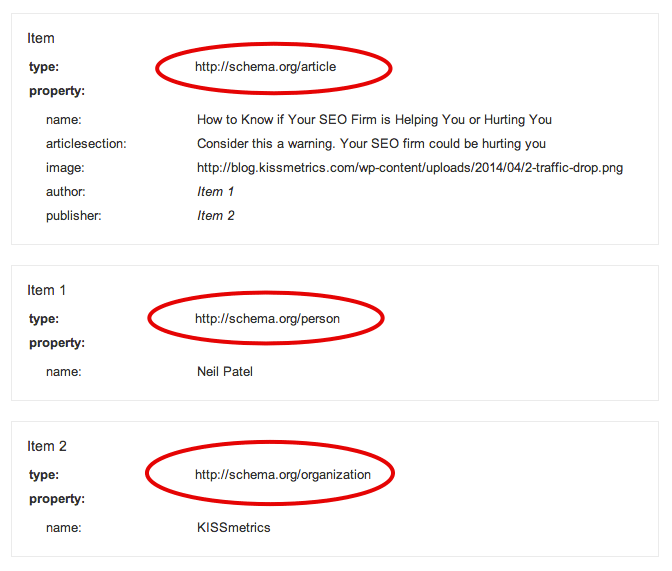
In addition, I can inspect every markup element that I added.
schema item type property
If necessary, I can edit the HTML directly in the testing tool in order to update the schema and preview results again.

Tips on using schema markup.

The purpose of this article was to get you started in the world of schema markup. It’s a big world.
The next few tips will show you how to dive even deeper, and gain even richer results from schema.

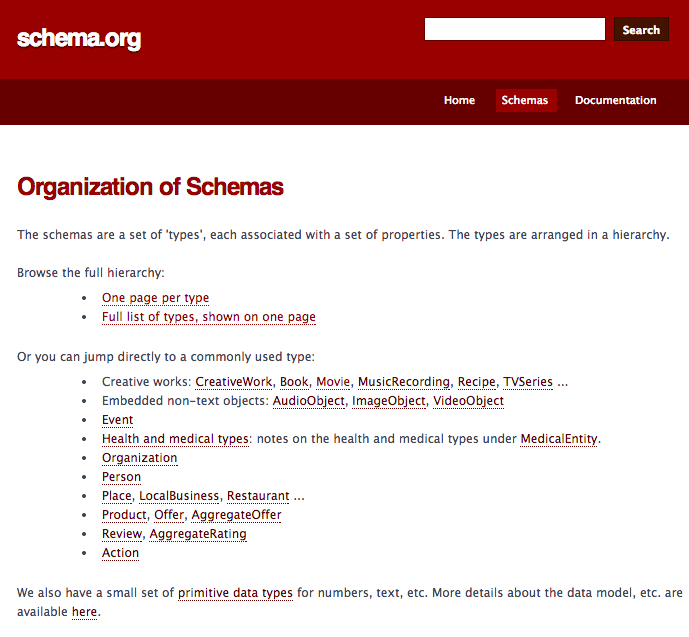
Find the schemas that are most commonly used.

Schema.org provides a list of the most common types of schema markup. You can visit the Organization of Schemas page to see this list. Check out the types that are best suited to your business.
organization of schemas

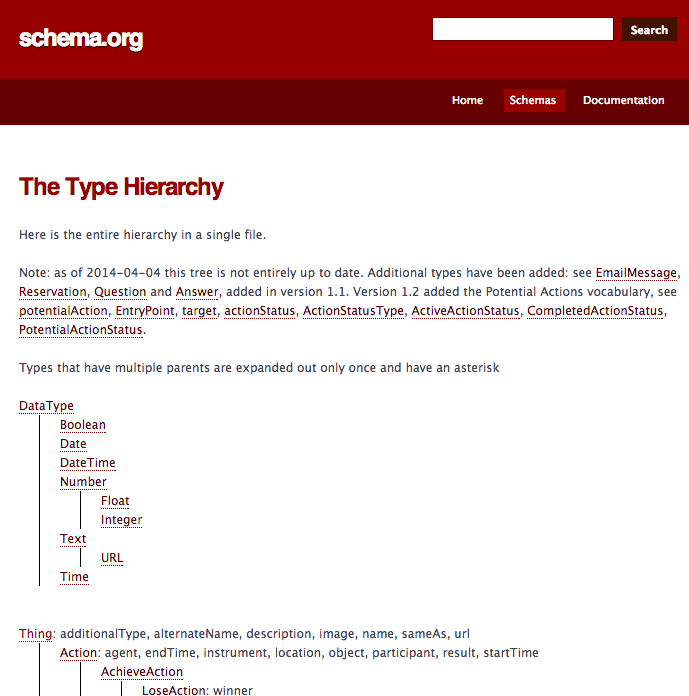
Find any and all schema types that you need.

As I mentioned previously, there is a myriad of markup types. To get the full list, visit The Type Hierarchy. This master list provides most of the markup types that are available.
schema.org the type hierarchy

The more you markup, the better.

Schema.org’s instructions explain clearly, “the more content you mark up, the better.” When you start understanding the vast array of itemtypes, you begin to see just how much there is on your web page that you can mark up.
Keep in mind the disclaimer, however: “You should mark up only the content that is visible to people who visit the web page and not content in hidden div’s or other hidden page elements.”

Schema Markup for Now and the Future

As simple as schema markup is to implement, it’s surprising how few businesses and websites have taken advantage of it.
Schema markup is one of those SEO innovations that will probably be with us for a long time. Now is the time to learn and implement the relevant microdata to improve your search results. Doing so right away will put you ahead of the curve, giving you a leg up on the competition.
How do you use schema markup for your company’s website?

8 Jan 2015

The 10 Basics of Blogging Search Engine Optimization - SEO

Stay active
Last Update September 30th, 2014

Found your blog the other day and have learned MUCH more than the previous 100 blogs I had found combined. I see that you have an article about SEO secrets below but I was wondering if you can direct me to like an “SEO for idiots” type of thing… I really need to understand the basics.
So here you go Kelci. Here are the 10 basics of blogging search engine optimization.
Oh, and this isn’t really for idiots. None of my readers are idiots. And if you are learning about SEO so you can grow your blog you are a long way from being idiotic.

A crude illustration of how SEO works

Let me start by giving you a crude example of how Google SEO works.
Google has developed automatic algorithms that rank your site. They send out what are called “spiders” to “crawl” your site and check it for over 100 indicators that determine whether your site is valuable or useless. These indicators include things like backlinks, domain age, traffic, fresh content, etc.
SEO is the art of making sure those spiders are happy with that they find. It is an extremely complex field that is constantly changing but in all that chaos there are a few constants that have remained true since the beginning. I’ll talk about those here.

The 10 basics of blogging SEO

As always guys and gals, if you have any other tips please leave me a comment and add to the fun. I absolutely love reading the huge comment-essays that you all tend to write.
1. You need your own domain and hosting
The first thing that beginners need to know is that you need your own domain and hosting. Free blog set ups do not do any favors for your SEO efforts.
Why is that?
Well many people speculate that if you were really serious about your website you would get your own name and host it yourself. And Google only wants to point to websites that are considered serious and trustworthy.
I recommend all new bloggers get their own domain and hosting setup right from the beginning. You can read more about why in my blog hosting review that I did recently.
BlueHost is where I got started and they now give you a free domain name when you open a new hosting account with them.
2. Solve problems with original content
You have to remember that Google’s whole purpose is to provide their customers with relevant and useful search results. Everything they do is built around the premise.
And, to be realistic, the most important thing you can do for your SEO is create massively useful content that solves people’s problems. If you are solving problems that people are searching for then it is likely that you are going to get shared on social media and ranked in Google.
The phrase “original content” means so much more than just blog posts nowadays. You should start expanding into:
  • Photography
    Get on Flickr or Photobucket and use original images on your blog. Even better if you take them yourself.
  • Videos
    Make tutorials or do video posts with your webcam. This builds links and traffic from Youtube and does well on mobile devices.
  • Podcasts
    iTunes is growing fast as people get better smart phones and spend more time plugged in. You can check out my podcast right here.
  • Tools and plugins
    If you can develop an original tool and install it on your website you can be assured of top Google rankings for a long time. Google absolutely loves tools and helpful plugins that people can use in their lives.
The idea is to build a relationship with your readers by helping them out. This will mean more sharing and faster results on the SERPS (search engine rankings positions).
3. Build relevant backlinks in a natural way
If you are just getting started with SEO you might know a little about backlinks. A backlink is when another website links back to your site from their site.
Not all backlinks are created equal though. Some things to know:
  • Never buy them
    I once heard about a guy who was the head SEO guy for an investment company. He bought some cheap backlinks on a domain name with millions of dollars and got the thing banned from Google. Never buy backlinks. Google is on to them.
  • The source matters
    The blog that is giving you the backlinks makes a huge difference. If it is an old domain name with excellent rankings itself then the backlink counts for more. One good link from an authority domain name (.edu and .gov ones are amazing) and your rankings change more than hundreds of little ones.
  • The anchor text matters
    The anchor text is the words that are used as the link. For example, just then I used “anchor text” as the anchor text. You want this to be relevant to your targeted keywords.
As mentioned, the best way to build quality backlinks is to write amazing quality content and then guest post on the best blogs in your niche.
Remember, backlinks to your OWN content is also really important. See how many links I have to my own articles in this blog post? Those count too!
NOTE: Using plain keywords as anchor text is no longer the recommended method. There needs to be a natural mix of keywords in your links.
4. Make sure your theme is SEO optimized
This is the topic of a whole series of posts so I’ll keep it brief.
Think of SEO as having two components: the off-site stuff like social media and backlinks and the on-site stuff like optimizing your theme.
Optimizing your theme is important because it helps give Google indicators that you are a trustworthy site. It also helps Google find your content. Some of the things you can do include:
  • Cleanly coded
    Make sure your theme is coded with the latest and greatest techniques so that it is easy to get around.
  • Fast loading
    A fast loading site is good for user experience and thus good for Google. Make sure your theme is pulling its weight and loading quickly. You can check out its speed here. You can use cache plugins to help speed things up.
  • Original
    Some people disagree but I still reckon that my original themes do better than themes that thousands of other people are using. A newly developed and original site also comes with dozens of other benefits.
  • No broken bits
    Make sure you clean up any broken links and make sure your navigation all works smoothly.
The best paid themes for SEO at the moment are those made over at Studiopress. Yep, Brian Clark again.
Having a well designed theme is also important for your brand. Separating yourself from the competition is a very important thing to do.
5. Fix your permalink structure
Permalinks are how people locate your blog and its internal posts and pages. They are made up of a root and an extension.
For example, on this post we have:
ROOT: blogtyrant.com/
EXTENSION: beginnger-blogging-seo/
Now, it is very important to have a good permalink structure. You can change this in WordPress by going SETTINGS > PERMALINKS and tweaking the options. The best option to have in there, in my opinion, is just the post name. So you should select CUSTOM STRUCTURE and then add /%postname%/
However, even better than that is to research what keywords you are trying to rank for and then shorten your URL to match those keywords. Take a look at this post and have a guess what key words I was trying to rank for.
Be warned! You don’t want to change the old permalinks because then any backlinks you have will be broken. Just new ones.
6. Install a sitemap
One of the easiest things you can do is install a Google Sitemap plugin that gives a full map of all your posts, pages and archives. The most common one that people use is this one and it seems to work quite well.
This automatically generates the sitemap for you at regular intervals and then submits it to Google, Bing, etc. on your behalf. Its literally giving them a map of your site so they can index it better.
7. Comment on other blogs
For a long time my SEO strategy consisted of just commenting on other authority blogs. Not only does it get you more traffic, exposure and new relationships, it also counts as a backlink.
Now, some blogs you can leave target anchor text because they aren’t real worried about user names. But on most blogs you need to use your real name. That’s fine.
Try and use Market Samurai to see where your competitors are getting their backlinks from. You might just find a bunch of them come from comments on well ranked blog posts.
8. Build your social media profiles big time
As I mentioned in my post on SEO secrets you want to now have a big focus on social media for SEO purposes as well as traffic building purposes.
Why?
Well because Google is now looking to social media as a signal of an article’s authority and relevance.
If thousands of people are tweeting about it then chances are you have written something pretty good. And the best way to get tweets is to build a loyal following and write killer content that they just love to promote for you.
Some things you need to start doing:
  • Tweeting big players
    Get to know the big players in your niche by casually building a rapport with them on Twitter. Down the track you can hit them up for re-tweets.
  • Add separate value
    Tweet and Facebook information and facts that don’t appear on your blog. Think of it as a separate resource for people to tap in to.
  • Share others
    The more content you share from other bloggers the more likely they are to share your stuff. Give and then get later.
Neil Patel (one of my blogging heros) has just written a really cool list about how to use Twitter like a boss. That is a good place to start if you want to really amp up your social activities.
NOTE: Google+ is now a huge factor in SEO rankings. Here is a post I did with some important Google+ tips to get your started.
9. Use SEO plugins
There are lots of WordPress plugins out there that you can install to get some help with your SEO. One of the best ones to start with is the All in One SEO Pack which does so many of the nasty little things for you.
There are a lot of other good SEO plugins out there so I thought I would open this one up to the audience and see what everyone else is using. Please leave a comment and let me know.
10. Read, study and use SEOmoz
As far as I am concerned the absolute best resource for SEO related material in the world is over at SEOmoz.
And their tools are even more amazing.
Now, the content on their blog might be a little over your head to begin with but you will slowly start to absorb ideas about trends, tactics and best practices over time. Even if you only check in every couple of weeks and read one or two articles you will find that your SEO knowledge just grows and blossoms.
Rand does a Friday Whiteboard session which, perhaps, is the most valuable video series I have ever watched. And he is a super cool guy.

What have I missed?

Okay guys. Hit me with it. What beginner SEO tips have I missed? Please leave everything and anything that you can think of in the comments section. I’m hoping we can come up with a nice sized list to help out all the newcomers.

Source from: http://www.blogtyrant.com/beginner-blogging-seo/

Related Posts:

The Greatest Toolbox for Blogging

Some of the tools I use in my blogging to do things more efficiently.
Please note: a few of these links are affiliates which means I will earn a small commission if you buy the item at no extra cost to you. These small sales are how I keep the site up and running and so your support is appreciated.

Blog hosting

  • BlueHost – My favorite host for one click WordPress installs, 24/7 support and an anytime money-back guarantee. This was the host I first got started on. Read my blog hosting reviews about them or follow my step-by-step guide to getting started.
    **Note: BlueHost is my recommendation for new bloggers. They have very kindly given Blog Tyrant readers a discounted rate of $3.49 per month for the first year!**
  • JustHost – One of the more popular shared hosting options for new bloggers. They do have 24/7 support but not in a live chat window like BlueHost does (which is really helpful).
  • KnownHost – I have used these guys for a few projects where I wanted a VPS environment. It’s a lot more complicated to set up than BlueHost but the support team are absolutely incredible.

Security

  • StrongVPN – The best way to use public WiFi and ensure that no one looks at your work or passwords. Change your IP location, be secure and anonymous.

SEO Tools

  • SEOmoz – The best SEO tool on the net. SEO recommendations, social media monitoring, much more.
  • Market Samurai – Keyword research, SEO analysis, back link finder.
  • Google Traffic Estimator – A great way to get a feel of how much traffic is available.
  • Backlink Checker – Find out who is linking to your blog.

Email marketing and subscriber management

Plugins

Photos and design

WordPress themes

  • Thesis Theme – Easy to use beautiful WordPress themes.
  • Studiopress Themes – Super customizable theme framework by Copyblogger that will change how you think about WordPress templates.
  • Tyrant Themes – Yep, this is happening.

Podcasting and videos

Surveys and Statistics

Related Posts:

20 Useful Free SEO Tools for Blogger


Aside from a nice-looking website with interesting and regularly updated content, SEO is essential to bloggers. While it’s entirely possible to do SEO on your own, due to the complexity of SEO rules to adhere to, it’s probably a lot more efficient to fall back on tools out there that are primed for helping your site rank higher.
SEOgadget Tools
Whether it’s full-featured toolsets, keyword suggestion engines or very specific site crawlers and link checkers, there’s a huge number of tools and services out there that can help you improve your blog’s SEO.
In this post, we are listing our 5 favorite SEO tools you can use for free, and if that is not doing it for you, there is a second list of 15 more tools to try out at the second part of the post.

Our Favourite 5

1. Majestic SEO

Majestic SEO is one of the most advanced and complete SEO services on the market, focusing specifically on link intelligence and domain-based metrics. The tools it has to offer include the Site Explorer, Backlink History tool, Keyword Checker, Comparator and a Clique Hunter. The comparative tools require a paid subscription, but the free account is enough if you’re only interested in your own blog(s).
Majestic SEO

2. IIS SEO Toolkit

The IIS SEO Toolkit has Site Analysis, Robots Exclusion, Sitemaps and Site Index modules. The Site Analysis module has a full-featured crawler engine as well as a Query Builder interface to generate custom reports. The Robots Exclusion module shows robots’ content and lets you set "allow" and "disallow" paths, while the Sitemaps and Site Index module lets you view, edit and delete sitemap and site index files.
IIS SEO Toolkit

3. Screaming Frog SEO Spider

Screaming Frog’s SEO Spider is an extensive website crawling tool that will help you analyze and audit your website for maximum search engine optimization. The SEO Spider checks your website’s links, CSS, scripts, images and apps to identify problems such as duplicate pages, broken links, URI issues and redirect errors.
Screaming Frog SEO Spider

4. Google Keyword Planner

Since most of your traffic is probably going to come from Google searches, you’ll definitely want to take a look at Google’s new Keyword Planner. Google’s Keyword Planner provides a wealth of information on currently popular keywords that you can further fine tune with advanced filtering options. Keyword Planner also has a historical view, letting you see the popularity of keywords over a twelve-month period.
Google Keyword Planner

5. Virante SEO Tools

Virante offers a number of on-site and off-site SEO tools for free on their website. On-site tools include a Duplicate Content Tool, an LDA Content Optimizer and a Density of Keyword Tool. Amongst the off-site tools are a Competitive Analysis Tool, a Link Atrophy Tool and a PageRank Recovery Tool. Virante also offer miscellaneous tools like a Clean IP Tool and a HTTP Header Check Tool.
Virante SEO Tools

More SEO Tools

It’s always good to have more choices. Here are 15 more SEO tools that bloggers can use for free. Let us know your favorite in the comments.

Web CEO

Web CEO is a complete SEO tool that comes in both online and offline versions. Like most SEO tools of this type, Web CEO has features such as rank checking, link management and analysis as well as on-site opitmization tools such as a Site Auditor that can scan your blog for broken links and other SEO-damaging errors. Web CEO operates on a freemium model.
Web CEO

SEO Book Tools

SEO Book has a number of free SEO tools available on their website. Just register a free account and you’ll be able to use tools such as their Keyword List Generator, Meta Tag Generator, Server Header Checker and Link Suggestion Checker, all for free. You can also download Firefox extensions such as their SEO Toolbar that provides competitive and search data directly in Firefox.
SEO Book Tools

SEOgadget Tools

SEOgadget provides a number of free SEO tools to help you with your SEO efforts. Some of the tools SEOgadget provide include a Link Categorization Tool for Excel, a Content Strategy Generator, Anchor Text Tool as well as a SEOgadget for Excel tool that allows you to interpret data from services such as Majestic SEO in Excel.
SEOgadget Tools

SEER’s SEO Toolbox

SEER’s SEO Toolbox is an all-in-one spreadsheet-based SEO toolbox that can be used to analyse data from sources such as Google Analytics, Majestic SEO and Twitter. It also has some on-page analysis tools and scraping abilities as well. Since it’s an online spreadsheet, your whole team (if you have one) can work on and analyse the data together.
SEER's SEO Toolbox

Internet Marketing Ninjas SEO Tools

The Internet Marketing Ninjas have more than a few free SEO, Webmaster and Social Tools on their website. Some of the SEO Tools include a Page Speed Tool, a Robots Text Generator Tool, a Meta Tag Generator Tool and a Search Combination Tool.
Internet Marketing Ninjas SEO Tools

SEO Tools For Excel

Niels Bosma’s SEO Tools For Excel is an Excel add-on that adds a number of SEO-centric features. Some of the functions added by SEO Tools For Excel include the ability to find duplicated content, check backlinks and obtain WhoIs data. SEO Tools For Excel can also analyse information such as the number of links and the meta keywords on your site.
SEO Tools For Excel

SEO Site Tools (Chrome Extension)

This is a Google Chrome extension that adds on-page SEO data drawn from various websites and services. It provides aggregated data from Google PageRank, Alexa traffic details, Quancast rank and Dmoz domain presence. It also provides information on meta tags, social media reactions and can even make suggestions to improve your site’s SEO.
SEO Site Tools Chrome Extension

SEOquake

SEOquake is an SEO plugin for Mozilla Firefox, Google Chrome and Apple Safari. SEOquake provides a wealth of information essential to any blogger looking to improve their site’s ranking, including information on Yahoo! Backlinks, Google page rank, Google and Bing indexing, WhoIs data and keyword density reports. It can also generate full page reports for any site you wish.
SEOquake

Moz SEO Toolbar

The Moz SEO Toolbar is available for both Mozilla Firefox and Google Chrome. It gives you access to typical SEO metrics in real-time as you browse the Internet. It can also highlight links and keywords on websites, as well as show all the page elements on a given website. It also has a detailed search engine results page (SERP) overlay that lets you compare Google, Bing and Yahoo! metrics.
Moz SEO Toolbar

Open Site Explorer

Open Site Explorer is a tool that you can use to investigate backlinks (both dofollow and nofollow links) on both your blog as well as competitor’s blogs. Open Site Explorer also provides domain and page authority rankings. The free version limits you to 200 backlinks per report, with detailed information is only available for the first five backlinks, but that should be enough for a basic overview.
Open Site Explorer

Ubersuggest

Ubersuggest is a keyword suggestion tool that suggests common sense keyword phrases based on Google’s own suggestion engine. Simply key in a query or keyword and Ubersuggest will provide a list of suggested keyword phrases based on your initial input. Ubersuggest can also be told to base suggestions on specific Google services such as Google Images, Google Video and Google News.
Ubersuggest

Google SERP Snippet Optimization Tool

This tool helps you optimize your pages’ title and meta description tags in order to maximise the appeal of your websites when seen in Google search result listings. It’s a simple tool that generates a preview of the Google SERP so that you can make sure that your and meta description tags don’t exceed the optimal length.
Google SERP Snippet Optimization Tool

Browseo

Browseo is a quick and simple web app that lets you look at websites as a search engine would. This lets you view your blog purely from an SEO perspective quickly, without having to dig into the code. The best thing is that there are also Android and iOS versions, so you can check your blog’s SEO optimization on the go.
Browseo

Anchor Text Over Optimization Report

This simple web service checks your site for any over optimized anchor text that may result in your site falling foul of Google’s search algorithms. Just input your site’s URL and the service will generate a list of keywords and keyword phrases with measurements on how optimized or over optimized these keywords are.
Anchor Text Over Optimization Report

Xenu’s Link Sleuth

Xenu’s Link Sleuth is an essential tool to check for broken links on your website, including partial checking of FTP, Gopher and e-mail links. The app also supports re-checking of links, SSL websites and can also detect and report redirected URLs. Xenu’s Link Sleuth can generate a simple report of all the issues it finds as well as generate a sitemap.

12 Nov 2014

Making Money From Blog

Part 1 of 6: Laying the Groundwork

  1. Start Making Money Blogging Step 1 Version 3.jpg
    1
    Understand what a blog is. Define a blog as a type of website or part of a website often maintained by someone making regular entries of commentary, descriptions of events, or other material such as graphics or video. Most blogs are interactive, allowing visitors to leave comments and even message each other via widgets on the blogs and it is this interactivity that distinguishes them from other static websites. A typical blog combines text, images, and links to other blogs, web pages, and other media related to its topic. The ability of readers to leave comments in an interactive format forms a large part of a blog.
  2. Start Making Money Blogging Step 2 Version 3.jpg
    2
    Plan to write your blog in a tone appropriate to your blog topic. The most important part of any blog is what you have to say and how you say it. People will inevitably return to your blog if the subject you write about and the style in which you write it appeals to them. Keep it personable so as to invite interaction through blog comments and links back to your blog from other bloggers who like what you write.
  3. Start Making Money Blogging Step 3 Version 2.jpg
    3
    Choose a niche market and domain name. If you’re setting up a blog with the intention of making money, you need to find a profitable niche. Let’s assume that selling hair care products is a potentially profitable niche. A possible search term that someone might use for a hair care product might be "hair care shampoo," so an appropriate domain name would be "haircareshampoo.com".
    • Selecting a good "buyer keyword" is critical. Try to select one that pulls in readers that are ready to buy. Another good example of a long-tail buyer keyword might be "eczema remedy." This keyword probably has a high level of competition, but it's just an example. Think of the reader who is searching for this term. They likely have a problem (eczema) and they're already looking for a solution. If your blog is informative and well designed, there's a good chance you'll be able to monetize your traffic.
  4. Start Making Money Blogging Step 4 Version 3.jpg
    4
    Choose which blog software to use. There are a number of popular blogging software around, including Blogger and Wordpress. My favorite is Wordpress – in fact I created this blog using Wordpress, and that’s the one I’m going to use to help you setup your blog - it’s very simple to use, and it has many powerful features including plug-ins and web template system that uses a template processor
  5. Start Making Money Blogging Step 5 Version 3.jpg
    5
    Go to your new blog website. (Such as www.yourblogname.com) Substitute your actual domain name for "yourblogname".
    • Click on “Cpanel login.” If you don’t see "Cpanel login" to click then type this in the browser address bar +slash+cpanel. “www.yourblognam.com/cpanel using the actual name you registered.
    • Type in your username and password that you chose when you bought the "web hosting" provider. Should be in your BLOG FILE.
    • Scroll down to “Software/Services.”
    • Click on “Simple Scripts.”

    Part 3 of 6: Designing and Creating Your Site

    1. Start Making Money Blogging Step 11 Version 2.jpg
      1
      Create a blog design that reflects your blog's image. It’s important that you create a design that reflects the content and image of your blog - from your font to your color choices, make sure each element of your blog's overall design is consistent with your blog's image. For example:
      • In a serious blog about marketing, it would be confusing in readers' minds, if the blog design included cartoon like clipart, balloon fonts and glitter effects.
    2. Start Making Money Blogging Step 12 Version 3.jpg
      2
      Choose elements that often make up a blog including:
      • About Me
      • Categories
      • Posts
      • Contact
    3. Start Making Money Blogging Step 13 Version 3.jpg
      3
      Install a theme for your blog. Under appearance, click on "Themes" and then click "Install Themes". From here, you can browse through a number of different themes from which you can select one you’re happy with.
      • Download the theme plugin and save it in a sub-folder on your computer.
      • Open the zipped folder.
      • Click “extract all files”
      • Upload files or a folder to “wp-content/plugins” on your “remote server” via FTP on FileZilla.

    Part 4 of 6: Starting to Blog

    1. Start Making Money Blogging Step 14 Version 3.jpg
      1
      Write blog posts people want to read. It is a matter of speaking honestly and openly about a subject you're passionate about. The more you promote your blog, the more people will find it and the greater likelihood that some of those people will read what you have to say, like it,
    2. Start Making Money Blogging Step 15 Version 3.jpg
      2
      Use strategies to drive traffic to your blog:
      • Email Marketing: send emails to your contacts who might be interested in your blog and suggest that they forward your link to their contacts.
      • Participate in blog carnivals. Search online for them or check out BlogCarnival.com.
      • SEO: Optimize your site for search engines. One software I recommend is WebCEO, and there is a free version of it.
    3. Start Making Money Blogging Step 16 Version 3.jpg
      3
      Post relevant comments on related blogs for exposure to those readers. Register as a member using "yourblogname.com" as your username and:
      • Build links to your blog by posting comments on other blogs that have “dofollow” links which means that search engines will see those links. That helps to improve your exposure.
    4. Start Making Money Blogging Step 17 Version 2.jpg
      4
      Do video marketing. Creating a video for marketing is much easier than you think. The best software used for making a video is Animoto.
    5. Start Making Money Blogging Step 18 Version 3.jpg
      5
      Promote your blog. Use sites like "Yahoo! Answers" to drive traffic to your blog. You can also drive more traffic to your blog using some of the social networking sites:
      • Twitter
      • Facebook
      • LinkedIn
      • StumbleUpon
      • Digg
      • Reddit
    6. Start Making Money Blogging Step 19 Version 2.jpg
      6
      Be persistent and write good content . Once you have the basics down you’ll continue developing and learning more.

    Part 5 of 6: Making Money

    1. Start Making Money Blogging Step 20 Version 3.jpg
      1
      Get help from friends. One way to get a friend like this is to join a forum, like Digital Point, which is full of people looking to help each other for online business.
    2. Start Making Money Blogging Step 21 Version 2.jpg
      2
      Be smart about what programs you buy into.
      • Stay away from buying How to ebook scams about making money online.
      • Consider buying a system and eprogram that can completely automate everything -- from e-sales, e-credit card usage and e-downloads (delivery online) -- to everything else that is needed to keep sales, customer info and operate a successful business online.
    3. Start Making Money Blogging Step 22 Version 3.jpg
      3
      Choose, create and sell your own "e-product" that people will want to buy:
      • Information e-products may be quick to create and quick to market. The product that you would sell is digital and your space taken up is on your computer and on the online site harddrive. This method does not take years, nor require much help, nor take great funds to manufacture. You can create information products in as little as a a day or two, post it, and begin generating revenue. You need a special topic and a computer (no stock, no mailing or counting inventory). This takes no space in your garage, house nor a store because you do not have to buy any products to sell. For example:
        • Create a good ebook yourself and make money by marketing that online.
        • Create an "e-store" yourself and make money by marketing several e-products online.
    4. Start Making Money Blogging Step 23 Version 3.jpg
      4
      Sign-up for "Pay Per Click" with a site(s). With such a service, you get paid for visitors on your site clicking on other peoples' ads to be redirected to that other site. That may work by creating cookies that give you credit for sending a [legitimate] client. For example:
      • Google’s Adsense program: Google will read your article that you write and find "ads that are relevant" to it and display them next to or within the article. Having very relevant ads, can be of benefit to the readers, too.
    5. Start Making Money Blogging Step 24 Version 3.jpg
      5
      Do affiliate marketing. In this process, you sell someone else's products, but you must learn how to connect with your buyers on a more fundamental level, using unconventional strategies and techniques, mixed in with more conventional methods such as the pay per click.

    Part 6 of 6: Creating a Community

    1. Start Making Money Blogging Step 25 Version 2.jpg
      1
      Keep it up. As you write quality content, your audience will start to build. The building of followers makes creating a membership site a logical way for readers to communicate with each other via forum, or messaging.
    2. Start Making Money Blogging Step 26 Version 3.jpg
      2
      Consider memberships. Membership sites are a terrific way to make money. You charge a small monthly fee for users to gain access to exclusive content, video content, or possibly direct access to you through Q&A or live events.
     Source from:http://www.wikihow.com/Start-Making-Money-Blogging